
Vitamin D supplements come in many strengths and forms, from low-dose daily tablets and capsules to high-strength liquid preparations and nano emulsion products. The biggest mistake is to assume that a larger number on the label automatically means a better supplement. Vitamin D requirements depend on age, health status, dietary intake, sunlight exposure and whether a person is being treated for deficiency. The right dose is the one that matches the clinical need and can be used safely and consistently.
Quick Answer
For healthy adults, the usual dietary reference intake is 600 IU daily from age 19 through 70 and 800 IU after age 70. Higher-dose vitamin D may be appropriate in selected situations, including documented deficiency or specific clinical indications, but high-strength products should not be used casually. The 2024 Endocrine Society guideline generally favors daily, lower-dose vitamin D over intermittent higher-dose regimens in adults aged 50 years and older who have an indication for supplementation or treatment. A nano shot may offer a useful formulation option, but the strength and schedule should follow the product directions and, when treating deficiency, a healthcare professional’s advice.
The Number on the Label Is Only One Part of the Story
Vitamin D3 is cholecalciferol, a fat-soluble form of vitamin D. The label may show the amount in micrograms, International Units, or both. For adults, 1 microgram of vitamin D equals 40 IU. The reference intake for adults 19 to 70 years is 600 IU per day, while adults older than 70 years have a reference intake of 800 IU. These figures represent average daily requirements, not a universal treatment dose for deficiency.
Why High-Strength Vitamin D Exists
A high-strength dose can be useful when a clinician is correcting deficiency or when a specific regimen is indicated. However, high-dose vitamin D is not simply a stronger version of everyday nutrition. The body stores vitamin D, and excessive supplemental intake can raise calcium levels too much. For adults, the usual tolerable upper intake level is 4,000 IU per day from all sources unless a healthcare professional recommends otherwise for a defined period. Treatment regimens can differ from the upper limit and should be medically supervised.
Daily Pills Versus Targeted Nano Shots
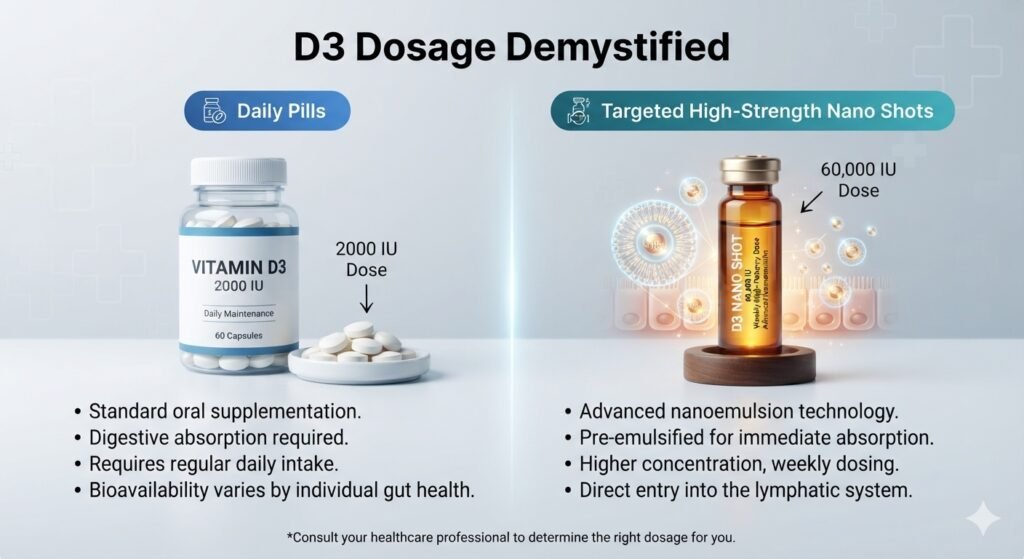
Daily tablets or capsules are convenient for routine supplementation. Liquid or nanoemulsion preparations may be useful for people who prefer a liquid format or when formulation characteristics are important. In a randomized crossover study of 24 healthy adults, a 60,000 IU nanoemulsion oral solution produced 36% higher relative bioavailability than a conventional soft-gel capsule after a single fasting dose. That is evidence of a pharmacokinetic difference, not proof that every nano product is clinically superior or that everyone needs a high-strength dose.
Consistency Matters More Than Chasing a Bigger Dose
Vitamin D supplementation works as part of a consistent plan. Taking an unnecessarily large dose because a smaller one feels less impressive can increase risk without adding benefit. The 2024 Endocrine Society guideline recommends against routine supplementation above reference dietary intakes in generally healthy adults younger than 75 and favors daily lower-dose vitamin D rather than intermittent higher-dose therapy in adults 50 years and older when supplementation or treatment is indicated.
How to Choose a Dose Safely
First ask why you are taking vitamin D. If you have a diagnosed deficiency, malabsorption, osteoporosis, kidney disease, or another medical condition affecting vitamin D metabolism, your clinician may use a specific treatment regimen. If you are simply trying to meet nutritional needs, a lower daily amount may be appropriate. Keep track of vitamin D from all supplements and fortified products, and do not combine multiple high-dose products without checking the total intake.
FAQs
Q. Is a 60,000 IU vitamin D shot safe for everyone?
No. A high-strength dose is not a routine requirement for everyone. Such doses may be used in specific treatment or supplementation schedules, but the appropriate frequency depends on the person and the clinical reason for use.
Q. Are nano shots better than vitamin D tablets?
Yes, but more research is needed. Human studies show that some nanoemulsion formulations can have higher bioavailability than conventional formulations, but this does not mean every nano product is superior or that higher bioavailability always produces better clinical outcomes.
Q. Should I take vitamin D every day or once a week or month?
The schedule depends on the dose, indication and individual circumstances. For adults aged 50 years and older who require supplementation or treatment, the 2024 Endocrine Society guideline favors daily lower-dose vitamin D over non-daily higher-dose regimens.