
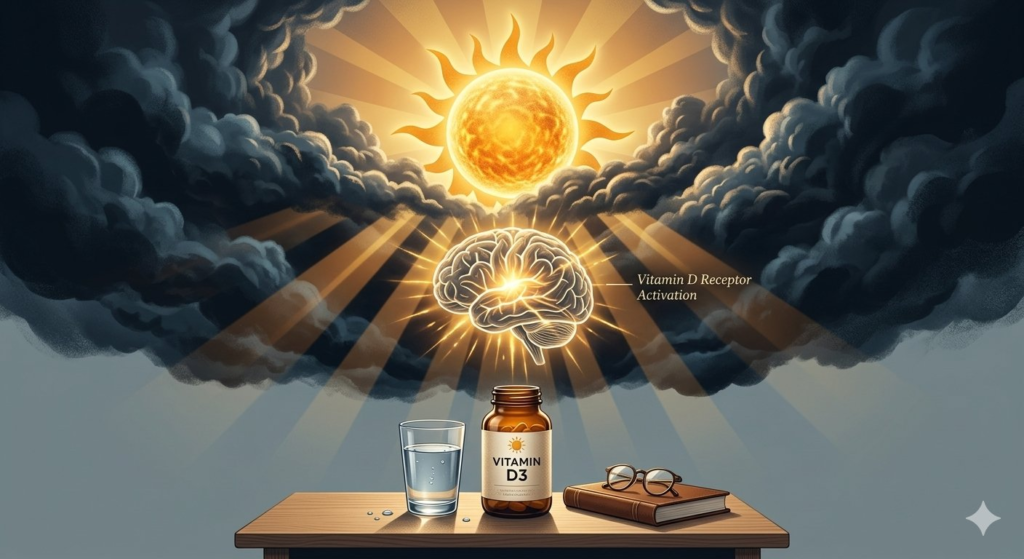
“Vitamin D is the sunshine vitamin” isn’t just a catchy phrase. Your brain has Vitamin D receptors in the exact regions that regulate mood, and the science increasingly backs up what people have long suspected: when your levels are low, your mood often follows.
Quick Answer
Vitamin D plays a real, biologically established role in mood regulation, and the research shows a meaningful payoff for the people who matter most here, those who are deficient and dealing with low mood. A major 2024 meta-analysis of over 24,000 participants found that Vitamin D3 supplementation measurably reduced depressive symptoms, with the strongest effects in people who already had depressive symptoms and improving further at higher doses. Given how common Vitamin D deficiency is in India, particularly among people with limited sun exposure, checking your levels and correcting a deficiency is one of the simplest, most evidence-backed steps you can take for your overall mood and wellbeing.
Why the Sunshine Vitamin Idea Holds Up
Vitamin D receptors are present in areas of the brain involved in mood regulation, and Vitamin D plays a role in the synthesis of serotonin and other neurotransmitters linked to mood and well-being. This isn’t a coincidence of naming, it’s a real biological pathway. On top of this, people with low blood Vitamin D levels are consistently more likely to report depressive symptoms across a large body of research. Put together, this gives the Vitamin D and mood connection a genuine scientific foundation, not just popular wellness folklore.
What the Research Shows
A large 2024 systematic review and dose-response meta-analysis, published in the journal Psychological Medicine, pooled results from 31 randomised controlled trials involving over 24,000 participants. It found that Vitamin D3 supplementation produced a measurable reduction in depressive symptoms overall, with the effect considerably stronger in people who already had depressive symptoms at the start of the trial. The analysis also found a clear dose-dependent pattern: the benefit increased at higher daily doses, with the strongest effects seen in people supplementing at higher intakes.
This is a meaningful, real-world finding: for people already dealing with low mood, correcting a Vitamin D deficiency isn’t a stretch; it’s a supported, evidence-backed step that can genuinely help, particularly when it’s addressing a real deficiency rather than a level that was already adequate.
Why Some Studies Show Less Effect, and What It Actually Means
In the interest of giving you the full picture, it’s worth mentioning a large 2020 trial, VITAL-DEP, published in JAMA, which followed over 18,000 generally healthy older adults for five years and found no significant difference in depression risk between those taking daily Vitamin D3 and those on placebo.
Here’s the important context: the participants in that trial were, by design, not depressed and largely not deficient to begin with. What this tells us isn’t that Vitamin D doesn’t matter for mood, it’s that taking more Vitamin D when your levels are already sufficient doesn’t add extra benefit, which is exactly what you’d expect from any nutrient. The real story across the research is consistent: correcting an actual deficiency in someone who has one is where the benefit shows up. Given that a large share of Indians, especially those with limited sun exposure, fall into exactly this deficient category, this distinction matters less as a caveat and more as a reason to actually check your levels rather than guess.
Who Benefits Most
The evidence points clearly to a group who stand to benefit the most from addressing their Vitamin D status:
- People experiencing low mood or depressive symptoms, where correcting Vitamin D status has shown a real, measurable effect
- People who are Vitamin D deficient or insufficient, which describes a large proportion of the Indian population, particularly those with indoor heavy lifestyles
- People supplementing at doctor guided, adequate doses, since the research shows the benefit scales with properly correcting the deficiency rather than a token daily amount
If this sounds like you, or you simply haven’t checked your levels recently, this is a well supported, low risk place to start.
Seasonal Low Mood: A Related but Separate Story
Seasonal affective disorder (SAD), the dip in mood some people feel during darker months, is often mentioned alongside Vitamin D because both connect to sunlight. It’s worth knowing these involve overlapping but distinct mechanisms: reduced sunlight affects circadian rhythm and melatonin regulation, while Vitamin D deficiency is a separate nutritional factor that often coexists with the same low sun exposure. If seasonal mood dips are a pattern for you, it’s a great reason to get your Vitamin D checked alongside addressing the broader seasonal factors with your doctor.
What You Can Do About It
- Get a 25-OH Vitamin D blood test. This is the single most useful thing you can do, since it tells you definitively whether you’re in the group most likely to benefit, rather than guessing.
- If you’re low mood and deficient, talk to your doctor about a proper Vitamin D3 supplementation plan. The research consistently favours meaningful, adequately dosed correction over sporadic or low dose supplementation.
- Make it consistent. The benefits shown in research come from sustained supplementation, not occasional use, so building it into your daily routine is what actually moves the needle.
- Use Vitamin D alongside your existing care, not instead of it. In every study showing a benefit, Vitamin D supported standard treatment such as therapy or medication where needed, rather than replacing it. If you’re managing depression, keep your doctor in the loop as you address your Vitamin D status too.
FAQs
Can taking Vitamin D actually improve my mood?
If you’re deficient and experiencing low mood, yes, the evidence shows a real, measurable benefit, and it grows stronger at properly corrected doses. It’s one of the most evidence backed, low effort steps available for this specific group.
Is Vitamin D deficiency the same as seasonal affective disorder?
No, though they often travel together because both relate to reduced sunlight. Getting your Vitamin D checked is a sensible step if you notice seasonal mood dips, alongside talking to your doctor about the bigger picture.
Should I stop my antidepressant or therapy if I start taking Vitamin D?
No. Vitamin D works best alongside standard depression care, not as a replacement for it. Keep your doctor informed as you address your levels, and let them guide any changes to existing treatment.