
Vitamin D3 is sold as capsules, tablets, gummies, drops, syrups, nano liquids, sachets and sprays, and a clinician may give it by injection. The active ingredient is the same cholecalciferol in each, but the format changes how it is measured, swallowed and, in some cases, absorbed. The best form is the one that gives an accurate dose and that a person will take consistently. A new or “advanced” delivery format should be described as a different way of delivering vitamin D, not as a replacement for medical advice or a guarantee of better health.
Quick Answer
Soft-gel capsules and tablets are compact and have fixed doses. Drops, syrups and oral solutions suit infants, children and people who cannot swallow capsules, but need careful measuring. Nanoemulsion liquids disperse vitamin D as very small droplets in a water-based liquid, and one small crossover study found higher vitamin D exposure from a nanoemulsion oral solution than from a soft-gel capsule after a single dose. Single high-dose sachets and injections are for short-term treatment under clinician direction. No form has been shown to be better for every person, and the label strength and your clinician’s advice matter more than the format.
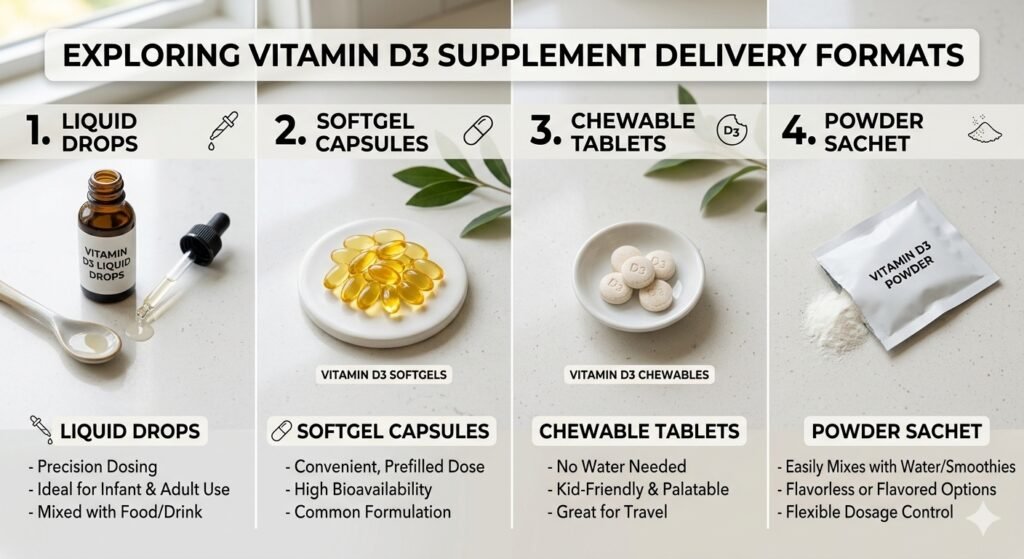
Common Forms Compared
| Form | Where it fits | Strengths | Limits |
| Soft-gel capsule | Daily adult use | Fixed dose, compact, oil-based | Needs swallowing; best with a meal containing fat |
| Tablet or chewable | Daily adult or child use | Fixed dose, easy to store | Check excipients and strength per tablet |
| Gummy | People who dislike pills | Pleasant to take | May contain sugar; check strength per piece |
| Drops | Infants and young children | Small volume, flexible dosing | Easy to mis-measure; per-drop and per-mL strengths differ |
| Syrup or oral solution | Children and adults who cannot swallow capsules | Easier to swallow | Sugar, volume per dose and storage after opening |
| Nanoemulsion liquid | Adults and children, depending on strength | Designed for water-dispersible delivery | Evidence is limited but new studies are emerging |
| Sachet or granules | Short courses of higher doses | Convenient single doses | Not for routine daily use unless prescribed |
| Oral spray | People who dislike swallowing | Small volume | Limited evidence; check sprays per dose |
| Injection | Clinician-supervised treatment | Bypasses the gut | Given only by a healthcare professional |
What “Nano” Means
In a nanoemulsion, vitamin D is carried in extremely small droplets of oil dispersed in a water-based liquid, which is designed to help it mix and be taken up in the gut. This is a formulation property, not a different vitamin. In the study of a 60,000 IU nanoemulsion oral solution, higher cholecalciferol exposure was seen than with a conventional soft-gel capsule under fasting conditions.
Same Dose, Different Form: What to Check
Whatever the form, check the strength per dose in IU or micrograms, the number of doses per pack, the ingredient list and the expiry date. Do not assume that a liquid, nano or “high absorption” product means you can take less or more than advised. If you switch from one form to another, add up the total daily vitamin D from all products so that you stay within the upper intake level of 4,000 IU a day for adults.
FAQs
Q. Are nano vitamin D3 products better than capsules? One study found higher vitamin D exposure from a nanoemulsion oral solution than from a soft-gel capsule.
Q. Can I switch from capsules to drops? Yes, if the strength per dose is checked carefully. Confirm the daily total with your clinician, especially for infants and children.
Q. Are gummies as reliable as capsules? They can provide vitamin D, but they may contain sugar, so check the label for strength per piece and for the recommended number of pieces.